
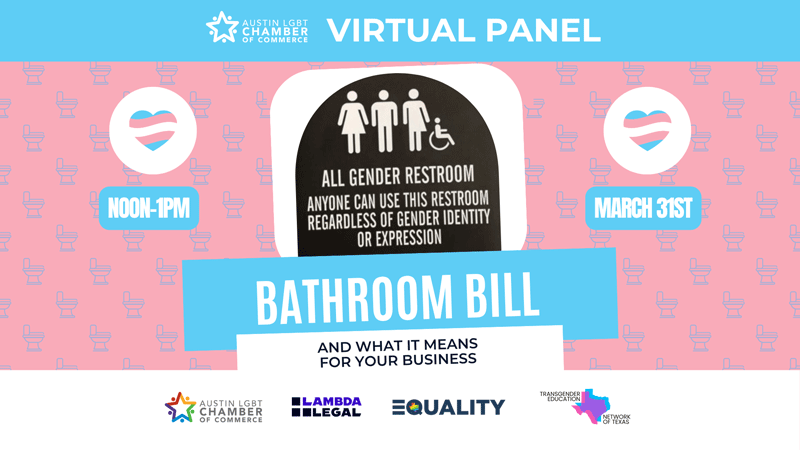
In recognition of Transgender Day of Visibility (TDOV), the Austin LGBT Chamber of Commerce hosted a timely and important virtual panel exploring Texas Senate Bill 8 (SB 8), commonly referred to as the “Bathroom Bill,” and what it means for businesses across our state.
There has been significant confusion surrounding this law — who it applies to, how it is enforced, and what responsibilities businesses actually have. This conversation was designed to bring clarity, context, and actionable guidance for business leaders navigating this moment.
Watch the full panel:
This discussion is for informational purposes only and does not constitute legal advice. Please consult your attorney or contact the Lambda Legal Help Desk for guidance specific to your situation.
What is the Texas Bathroom Bill?
Texas Senate Bill 8 went into effect on December 4, 2025, and applies specifically to publicly owned buildings, including government facilities, school districts, public colleges and universities, libraries, and certain publicly owned event spaces, airports, and more.
A key takeaway from the discussion: This law does NOT apply to private businesses.
However, confusion around the law has already led to inconsistent understanding and application across Texas.


What Businesses Should Know
Even though SB 8 does not apply to private businesses, it is influencing workplace decisions and customer experiences.
Private Businesses Are Not Covered
Businesses retain the ability to create inclusive environments for employees and customers.
Avoid Overcompliance
Panelists emphasized that some organizations are changing policies unnecessarily due to confusion. This can create harm and limit access where it is not legally required.
Federal Protections Still Apply
Workplace protections and non-discrimination laws at the federal level remain in place.
Inclusion Is Good for Business
Creating welcoming environments supports:
- Talent recruitment and retention
- Customer trust and experience
- Long-term economic growth
Real World Impact
One of the most immediate impacts of SB 8 has been widespread confusion.
Panelists shared that many individuals are unsure:
- Where the law applies
- What is allowed
- How it may be enforced
This uncertainty is already affecting daily behavior, workplace dynamics, and public interactions.
Q&A Highlights
Here are a few key questions that came directly from attendees during the live session:
No.
SB 8 applies only to publicly owned buildings, including government facilities, schools, and certain state-run spaces. Private businesses are not subject to this law. 
Panelists emphasized that businesses should not change policies unnecessarily based on misinformation.
Short answer: potentially, yes.
Panelists noted that SB 8 applies to spaces that are “owned, controlled, or operated” by a public entity. This means that if a business is leasing space within a publicly owned building — such as a county-owned facility — there may be increased scrutiny or expectation of compliance. 
While there is still some ambiguity in how this will be interpreted and enforced, panelists advised that businesses in these situations should be aware of the potential for broader application and proceed thoughtfully.
The liability falls on the public entity, not the individual.
If a complaint is filed and not resolved, the building or public entity may be fined. Individuals using the restroom are not fined under SB 8.
SB 8 is enforced through a complaint-based process:
- A written complaint must be submitted to the public entity
- The entity has an opportunity to resolve the issue
- If unresolved, the complaint may escalate to the Attorney General
Panelists noted that enforcement remains unclear in practice and may vary by situation.
Panelists noted that in Texas, individuals are not fined, and enforcement centers on public entities.
However, there is still some uncertainty depending on how specific facilities are classified and operated, which contributes to broader confusion around the law.
Yes.
Private businesses maintain full discretion and are not restricted by SB 8. Panelists strongly emphasized that businesses should not deny access based on a law that does not apply to them.
Panelists encouraged businesses to:
- Avoid overcompliance driven by confusion
- Continue inclusive workplace and customer policies
- Educate staff on what the law does and does not require
- Support employees and customers with clarity and care
Confusion.
Panelists shared that one of the most immediate impacts of SB 8 has been widespread misunderstanding — among both businesses and individuals.
This confusion has led to:
- Hesitation around everyday activities
- Inconsistent or unnecessary policy changes
- Increased discomfort in public and workplace environments
Panelists emphasized the importance of:
- Staying informed and sharing accurate information
- Supporting inclusive policies in workplaces and public spaces
- Building relationships with local leaders and policymakers
- Showing up — not just in moments of celebration, but in advocacy
The Role of Businesses
As a Chamber of Commerce, our work is rooted in economic opportunity and business success.
Panelists emphasized that businesses play a critical role in shaping inclusive, competitive communities by:
- Leading with accurate information
- Supporting employees and customers
- Staying engaged in policy conversations that impact the workforce
Creating welcoming environments is not only the right thing to do — it is essential for a thriving economy.
Resources & Additional Information
We’ve compiled resources shared by our panelists to help you better understand SB 8 and its broader implications:
👉 Texas Tribune Article: “Texas is restricting the bathrooms trans people can use in government buildings. Here’s how the law works” (Distills the law in a way that is easy to understand and highlights the main points).
👉 Dr. Ray Perryman – The Economic Benefits of Statewide LGBTQ Nondiscrimination in Texas
- The Potential Impact of a Comprehensive Nondiscrimination Act on Business Activity in Texas
- The Economic Benefits of Statewide LGBTQ Nondiscrimination in Texas
👉 TENT’s 89th Legislative Session Bill Breakdowns, which includes additional information on SB 8.
👉 Equality Texas Legislative Bill Tracker
👉 Equality Texas Civic Engagement Resources
(We will continue updating this section as additional resources are shared.)
Contacting TENT, Equality Texas, and Lambda Legal
TENT
- For general inquiries: info@transtexas.org
- Resource navigation, experiencing discrimination/challenges, information about current laws/policies: support@transtexas.org
Equality Texas
- Request for Support – Equality Texas collects data on anti-LGBTQIA+ incidents across Texas. If you have experienced or witnessed an incident, we’d like to hear about it. All questions are optional.
Lambda Legal
In Community
Following the panel, we were grateful to continue the day in person with a Transgender Day of Visibility Community Gathering and Happy Hour at El Raval.
More than 30 community members, partners, and allies joined us to connect, reflect, and be in community together. There were no photos from the evening — intentionally so. The focus was on creating space for real conversation, presence, and connection.
It was a meaningful reminder that while these conversations are critical, so too are the moments where people can gather, feel seen, and support one another.
Stay Connected
The Austin LGBT Chamber of Commerce is committed to supporting businesses with the tools, education, and community they need to navigate complex issues with confidence.
If you’re not yet a member, we invite you to join us.
🔗 https://austinlgbtchamber.com/join-the-chamber/